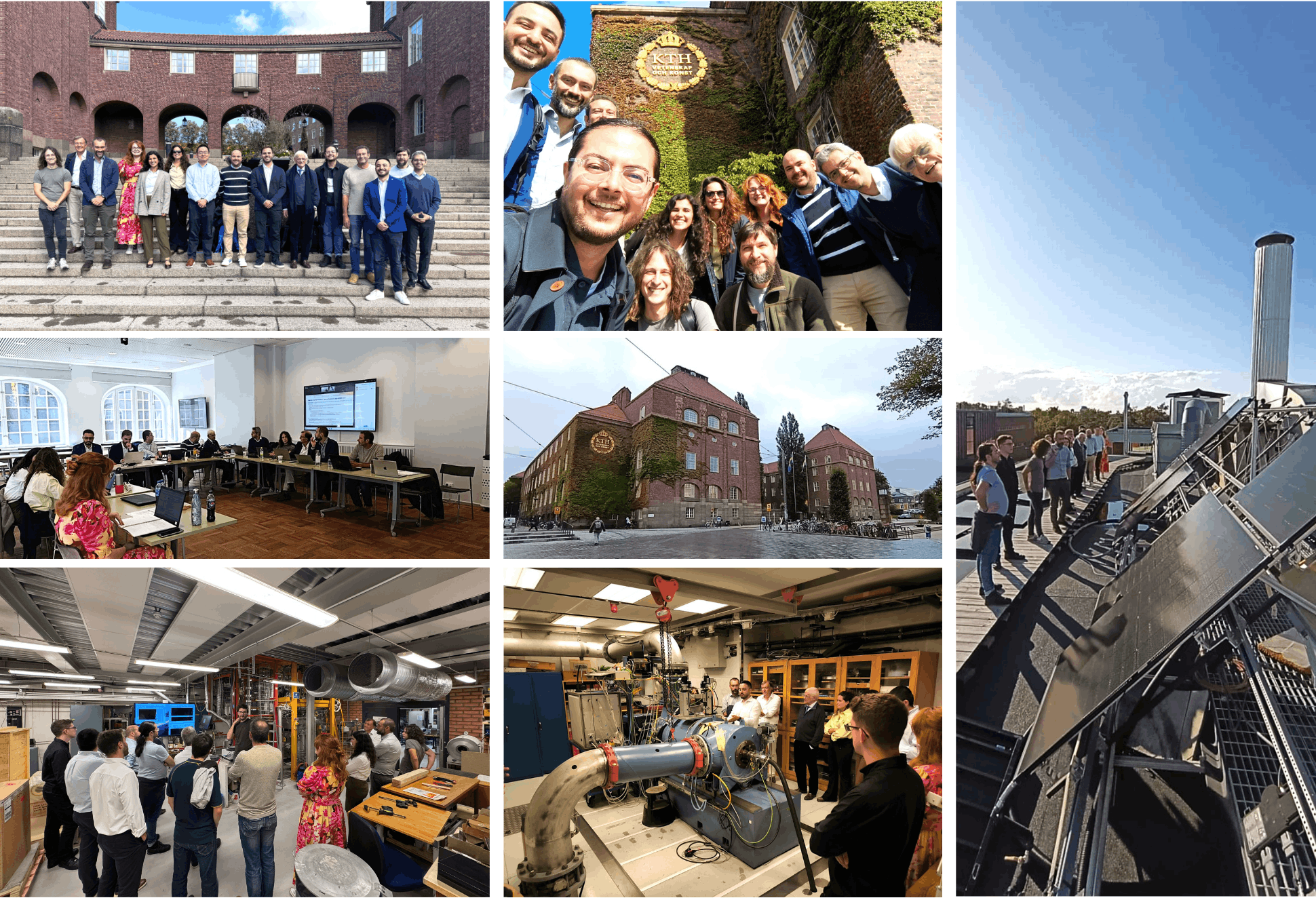
On 11 – 12 September 2025, the Powder2Power consortium gathered at KTH Royal Institute of Technology in Stockholm (Sweden) for the project 24-month Steering Committee and Executive Board meeting. The meeting brought together 20 participants from 9 partner organisations, providing an opportunity to review progress across all work packages and align on the next steps.
During the two-day meeting, partners presented the latest developments achieved during the project fourth semester. Discussions covered progress in particle conveying systems, solar receiver development, prototype testing activities, system modelling and techno-economic analysis, as well as dissemination and exploitation actions.
- Progress toward experimental testing
Significant progress has been made on the experimental infrastructure at the Thémis solar tower site, where upgrades to the solar receiver and instrumentation have been completed and preparations for experimental testing are advancing. The small particle loop installed at the top of the tower is nearing completion, with commissioning expected toward the end of 2025.
Meanwhile, the detailed design of the full particle loop and power block components is progressing, with most equipment already installed at ground level. These developments will support upcoming experimental campaigns and the integration of the different subsystems required for the future MW-scale demonstration.
- Prototype demonstration at KTH Energy Lab
As part of the meeting programme, consortium partners visited the KTH Energy Lab, where a live demonstration of the prototype electrical particle heater was carried out following testing performed by project partners. The visit allowed participants to observe the functioning of the prototype and discuss the next steps for scaling up the technology.
- Advancing modelling, techno-economic analysis and exploitation
Partners also reported progress on system modelling and techno-economic assessments, including the development of simulation tools and cost models that will support the evaluation of different plant configurations. In parallel, the consortium continues its work within the Horizon Results Booster initiative, focusing on three key exploitable results related to the solar receiver, particle conveying system and electrical heating technology.
The consortium thanks KTH Royal Institute of Technology for hosting the meeting and for the excellent organisation.