While the Powder2Power pilot is taking shape at the Themis solar tower in southern France, another equally important part of the project is advancing in parallel: the design of the future commercial-scale plants that could bring this technology to market.
Demonstrating the concept at pilot scale is a crucial milestone, but the broader ambition of Powder2Power goes far beyond a single prototype. The project aims to show how fluidised particle-based concentrated solar power (CSP) can evolve into a competitive, flexible and scalable solution capable of delivering both renewable electricity and high-temperature industrial heat.
Over the past two years, the consortium has made significant progress in defining how the Powder2Power concept could be deployed at utility scale. Researchers and engineers have developed commercial plant layouts, optimised solar receiver and heliostat field designs, evaluated advanced supercritical CO₂ (sCO₂) power cycles, and launched comprehensive techno-economic and environmental assessments. Together, these activities are laying the foundations for the industrialisation of a new generation of solar thermal power plants and thermal energy storage system.
From demonstration prototype to commercial plant architecture
At the focus of this work is a simple but essential question: what would a full-scale Powder2Power plant look like? To answer it, the consortium has developed integrated plant concepts for two main market applications.
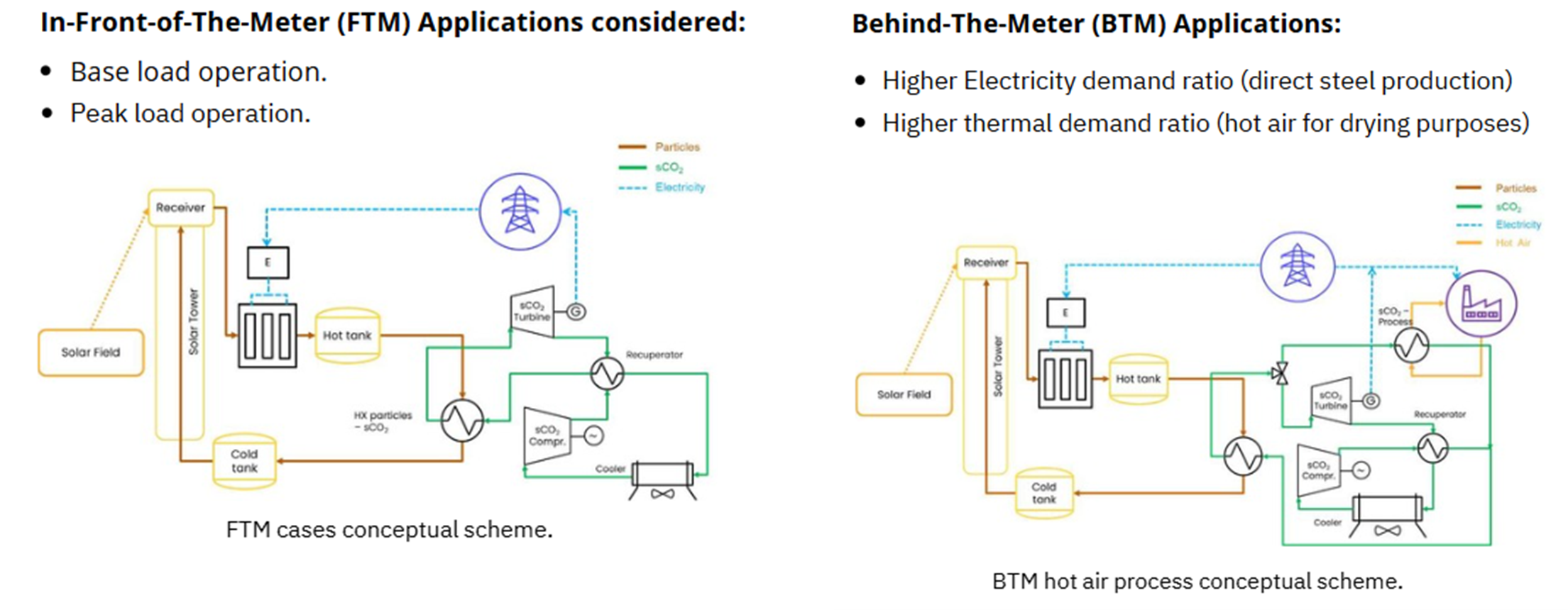
The first concerns front-of-the-meter (FTM) installations, designed to supply dispatchable renewable electricity directly to the grid. These systems target capacities ranging from approximately 50 to 100 MWe, making them suitable for peak-load electricity generation.
The second concerns behind-the-meter (BTM) installations, designed to provide electricity and high-temperature heat directly to industrial users. These smaller systems, generally below 10 MWe, are particularly relevant for sectors such as steelmaking, drying processes and other energy-intensive industries seeking alternatives to fossil fuels.
These concepts were developed through integrated system modelling and engineering studies that define how the solar receiver, particle transport system, thermal storage, electric heater and supercritical CO₂ power block interact within a single high-temperature energy system (read more here).
A flexible hybrid system combining sun, particles and renewable electricity
What distinguishes Powder2Power from conventional CSP technologies is its ability to combine several energy sources within a single integrated system.
Solar energy is concentrated by a heliostat field and absorbed by a cavity receiver, where fluidised olivine particles are heated to temperatures of up to 650°C. These particles act simultaneously as heat transfer and thermal storage media, enabling long-duration storage and dispatchable energy production. When additional thermal input is required, an electric heater powered by renewable electricity can further increase the particle temperature up to 750 °C. This hybrid approach allows the system to make use of low-cost electricity from photovoltaic plants or the grid, improving operational flexibility and creating new opportunities for grid services and sector coupling.
For industrial users, this means a robust source of carbon-free heat. For electricity systems, it offers a new pathway to integrate variable renewables while maintaining reliable, dispatchable generation.
Optimising the solar receiver and power block
Commercial-scale performance depends on the interaction between several highly interconnected components: the heliostat field, the solar receiver, the particle loop, the electric heater, the particle-to-sCO₂ heat exchanger and the power block.
To address this complexity, the consortium developed advanced numerical models combining solar field performance, receiver thermal behaviour and supercritical CO₂ Brayton cycles. These models were used to analyse plant configurations ranging from 10 to 100 MWe and solar receiver powers from 15 to 120 MWth.
One of the most significant findings concerns the selection of the optimal power cycle architecture, which was based in maximizing the total efficiency of the system:
- Recompressed sCO₂ cycles emerged as the most suitable option for smaller behind-the-meter applications.
- Partial cooling sCO₂ cycles offered the highest efficiency for larger front-of-the-meter installations.
These results confirm the strong potential of combining fluidised particle receivers with advanced sCO₂ technology to achieve efficiencies above those of conventional steam-based CSP plants.
From engineering design to techno-economic assessment
Designing an innovative energy technology is only the first step. To assess whether Powder2Power can become a competitive solution in future energy markets, the consortium has also carried out its first techno-economic evaluations of commercial-scale plants.
These studies combine detailed engineering models with cost estimation methods to analyse how different plant configurations perform under realistic operating conditions. The first assessments compare alternative layouts, including front-of-the-meter applications, and examine how design choices such as solar receiver size, electric heater integration and supercritical CO₂ cycle architecture affect both efficiency and cost.
This work is now being extended through more detailed analyses of Levelized Cost of Electricity (LCOE), environmental impacts and socio-economic benefits, providing a comprehensive view of the technology’s future market potential.
The early results will be presented at ESRE 2026 conference during Powde2Power Special Session.
Building the foundations for industrial deployment
Although much of this work takes place in simulation environments and engineering models rather than on the pilot site itself, it is essential to the long-term success of the project. By defining commercial plant architectures, identifying optimal operating strategies and evaluating economic performance, Powder2Power is transforming an innovative prototype into a credible industrial solution.
The pilot demonstration at Themis will provide the experimental data needed to validate these models and refine future designs. In turn, these commercial-scale studies are already showing how Powder2Power could support the decarbonisation of electricity systems and industrial processes across Europe and beyond.
Toward a new generation of Concentrated Solar Power
The vision emerging from Powder2Power is clear: a new type of concentrated solar power plant and storage system capable of storing energy at very high temperatures, integrating renewable electricity, delivering dispatchable power and supplying carbon-free industrial heat. By combining advanced solar receivers, fluidised particles, electric heating and supercritical CO₂ cycles, the project is opening a pathway toward more efficient and economically competitive CSP systems.
As the pilot prototype moves toward commissioning, the commercial-scale studies are demonstrating that the technology has the potential not only to work in the laboratory or at demonstration scale, but also to become a practical and scalable solution for the energy systems of the future.
Related resources:
- Fluidised particle-driven CSP integration model for MW-scale commercial applications
- Techno-Economic Analysis and Optimal Supercritical Carbon Dioxide Power Cycle Configuration for Novel Concentrating Solar Power Plants Adopting Tubular Fluidised Particles Central Receivers – D. Alfani et al., Journal of Engineering for Gas Turbines and Power (2025).
- The Powder-to-Power project: A MW-scale demonstrator of a solar plant using particles as heat transfer and storage media