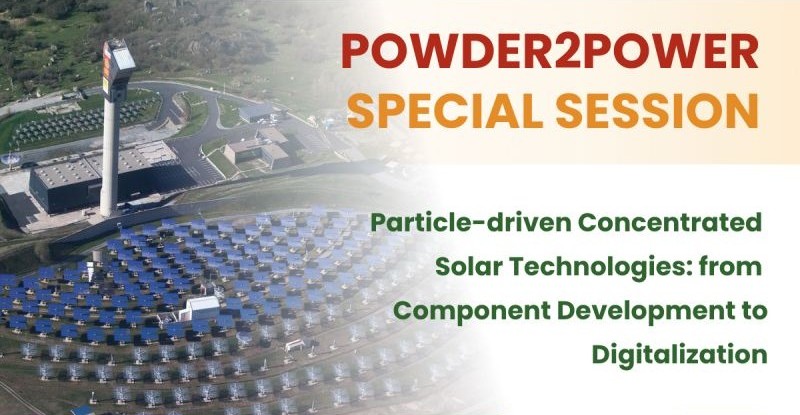
The Powder2Power project has reached a major milestone at the Themis solar tower in Targasonne, France, where the project MW-scale fluidised particle-based Concentrated Solar Power (CSP) prototype is approaching completion.
Over the past two years, the consortium has transformed the existing Themis research infrastructure into a new demonstration platform designed specifically for Powder2Power. This extensive work marks the transition from engineering and system design to the final stages of construction and operational validation, bringing the project significantly closer to real-world testing.
Reconfiguring the Themis solar tower research infrastructure for a New Generation of CSP
The Themis pilot is the heart of the Powder2Power demonstration. Its purpose is to validate an innovative CSP technology that uses fluidised particles heated to up to 750°C to store and transfer thermal energy for renewable electricity generation and high-temperature industrial heat applications.
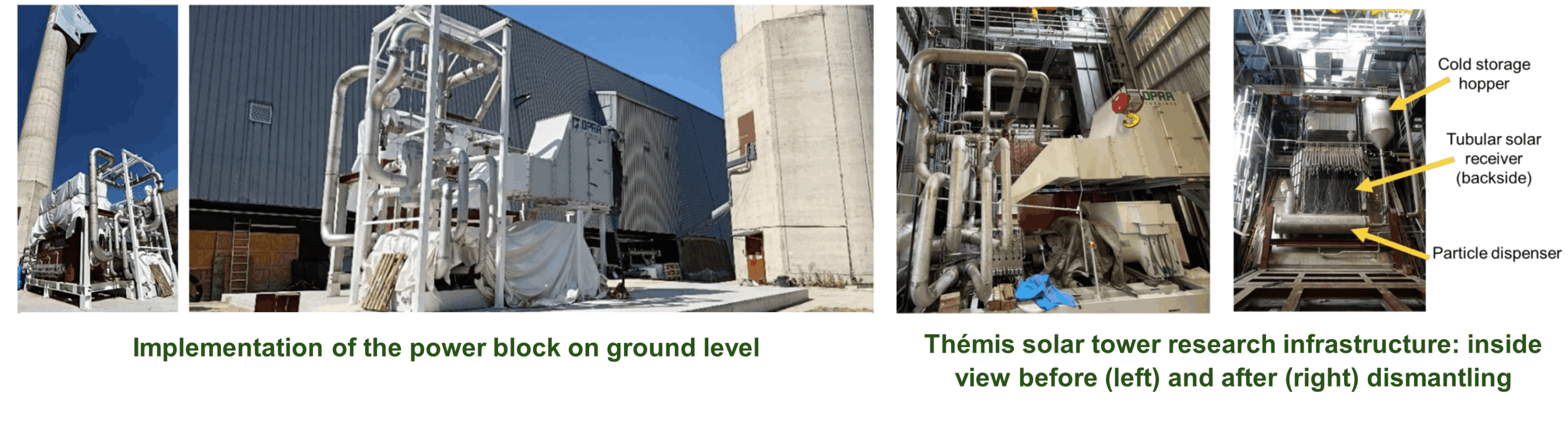
To accommodate this new concept, the consortium has reconfigured major elements of the former Next-CSP installation. Existing equipment has been dismantled, relocated, upgraded and reassembled to create a state-of-the-art research platform tailored to the Powder2Power process.
One of the most significant operations involved relocating approximately 50 tonnes of power block equipment, including the hot storage tank, heat exchanger, turbine and associated piping, from the top of the tower to ground level. This complex engineering effort required the removal of around 12 tonnes of particles, the renovation of the concrete slab at the base of the tower, and the construction of new support structures for the reconfigured system.
A small solar particle loop to accelerate and de-risk future testing
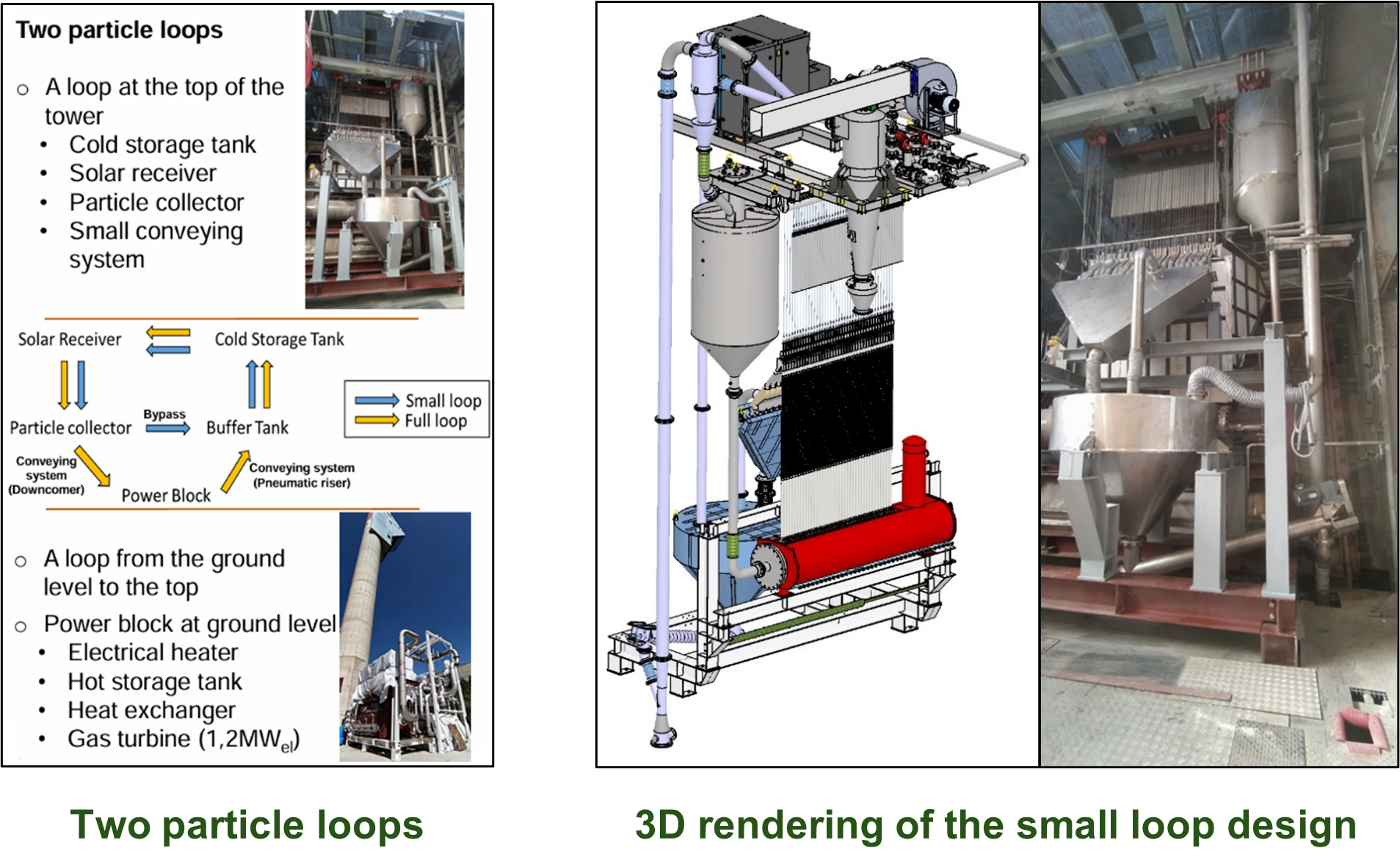 To begin experimental work before completion of the full pilot loop, the project has installed a small particle loop at the top of the tower. This compact system, which will be part of the full particle loop that includes the power block, makes it possible to test the upgraded solar receiver, gain operational experience with the particle handling system and collect data under representative conditions.
The small loop is also providing valuable information for the development of advanced control strategies, including artificial intelligence methods based on deep reinforcement learning. By enabling early experimentation, it reduces technical risks and helps prepare the team for the larger-scale testing campaign to come.
First solar receiver tests and advanced instrumentation
Reliable operation of a high-temperature particle receiver requires precise monitoring and control. 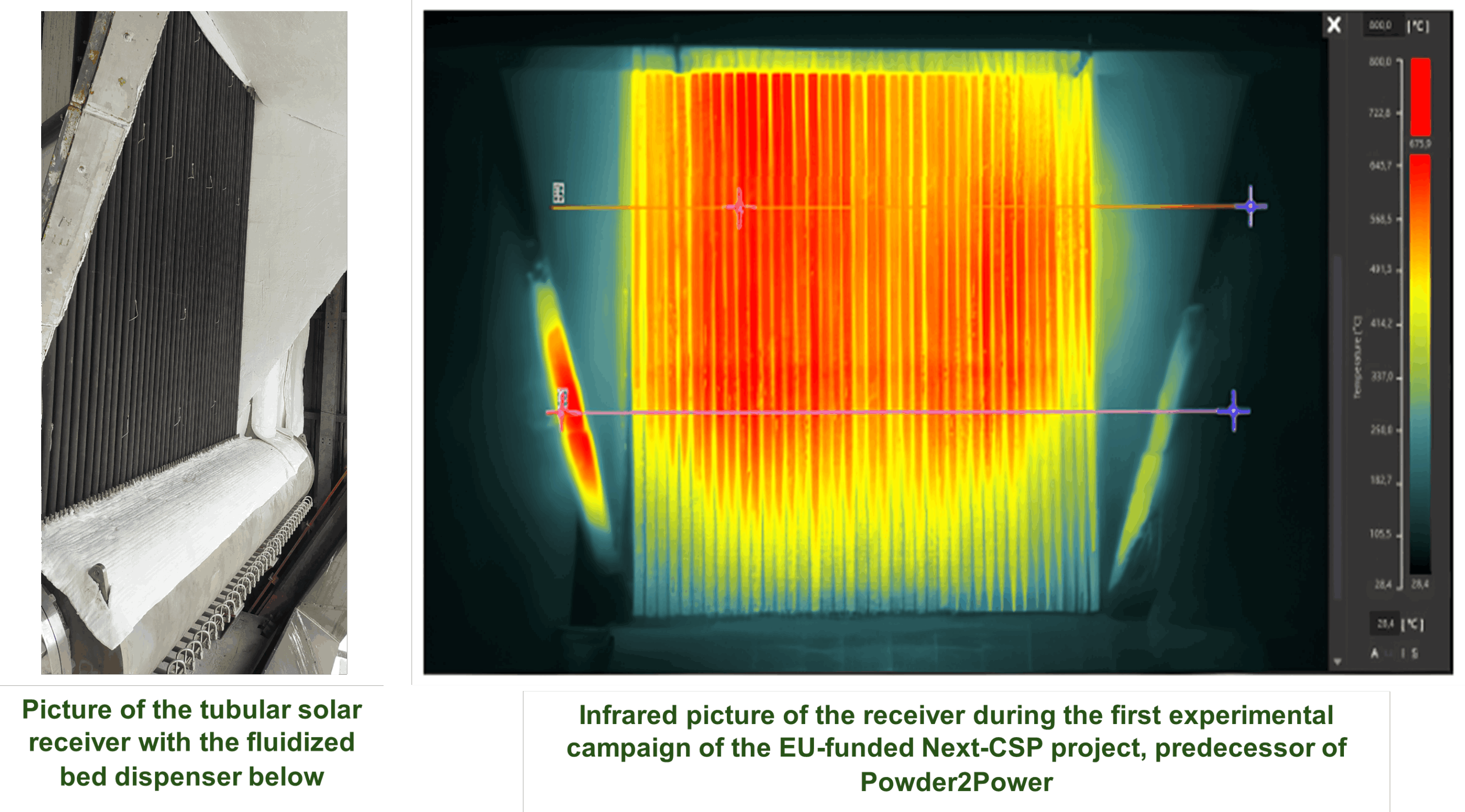
To achieve this, Powder2Power has implemented major upgrades to the Themis instrumentation and control systems.
A key improvement is the installation of 40 individually controlled mass flow meters, which regulate the secondary air injection in each receiver tube. This allows the consortium to maintain more uniform particle flow and improve temperature control across the receiver.
Additional developments include a dedicated control cabinet, updated acquisition and automation software, detailed Piping and Instrumentation Diagrams (P&IDs), and a new solar flux measurement system capable of reconstructing detailed flux maps across the receiver aperture.
These systems have already been validated during the first operational tests of the upgraded solar receiver, carried out both with and without solar input. The resulting data will support future commissioning activities and the development of advanced control strategies. Read more on the modelling and control approach underpinning this work.
Preparing for hybrid operation
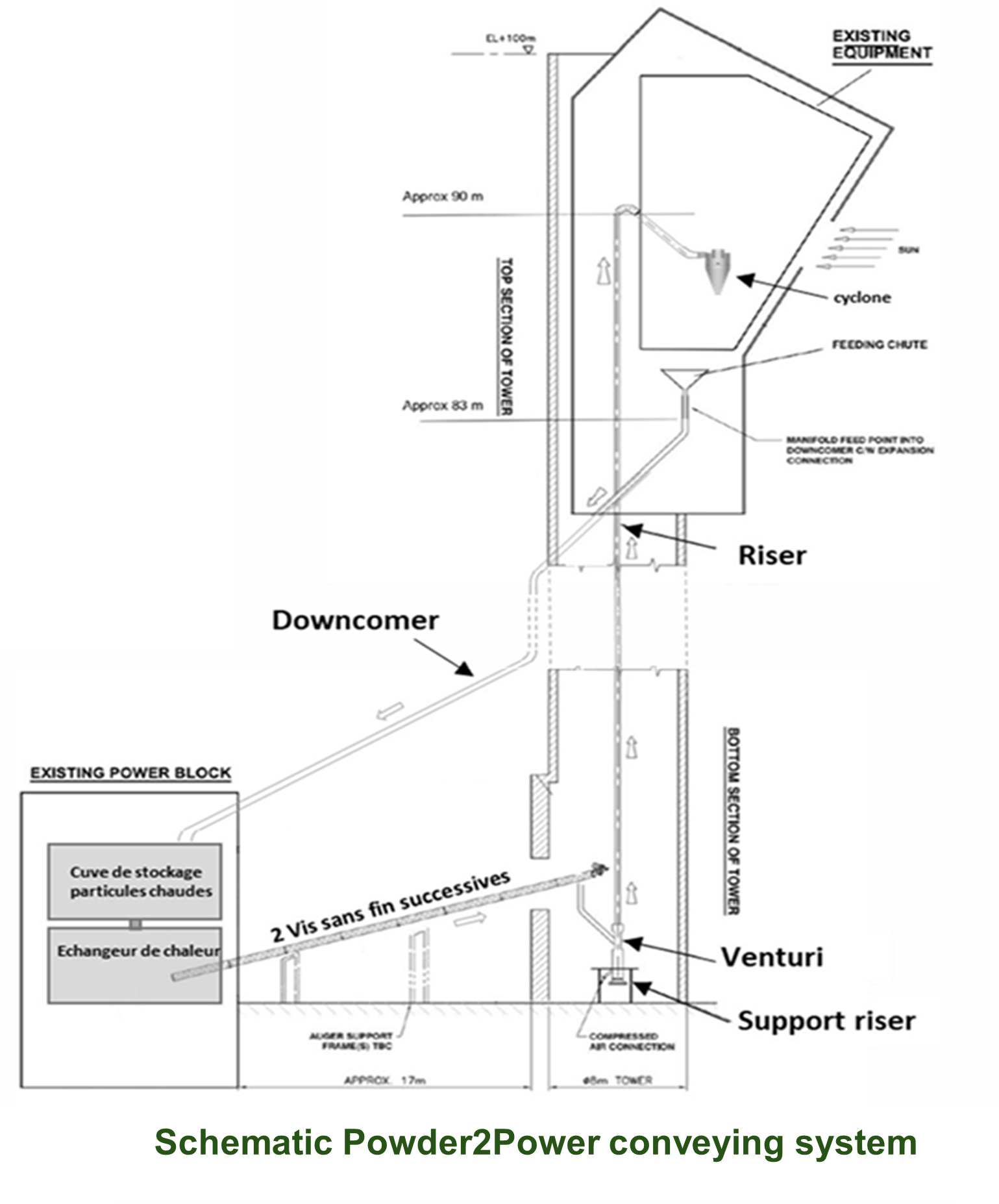 The next phase of the Powder2Power pilot will bring together two of the project’s most innovative technologies: the vertical particle conveyance system and the industrial-scale electric particle heater.
A central element of the new configuration is the particle transport system, designed to convey up to 16 tonnes of cooled particles per hour from the ground-level power block back to the solar receiver located 90 metres above at the top of the Themis tower. Developed jointly by KU Leuven, EPPT and PROMES-CNRS, this pneumatic system is one of the most distinctive engineering features of the Powder2Power concept and a key enabler of continuous closed-loop operation. The design and performance of this technology are described in a recent peer-reviewed study by Deng et al. (2026), which shows that the system can significantly reduce energy consumption compared with conventional bucket elevator solutions while maintaining high reliability and low heat losses.
At the same time, a 250 kW industrial-scale electric heating system will be integrated into the hot particle storage tank. Developed from the experimental work carried out by KTH Royal Institute of Technology and SEICO, this system will raise particle temperatures to 750°C and enable hybrid operation by combining concentrated solar energy with renewable electricity.
These technologies will provide the flexibility needed to maintain stable high-temperature operation, make use of surplus renewable electricity and demonstrate how concentrated solar power can evolve into a more versatile solution for renewable electricity generation and industrial decarbonisation.
From construction to commissioning
Following major modifications to the Themis infrastructure and the installation of key prototype components, Powder2Power is now moving into the final integration phase. The next steps include the installation of the particle conveyance system, final integration of the electric heater and preparation for commissioning activities ahead of the first large-scale experimental campaigns.
This transition from construction to commissioning represents one of the most significant milestones of the project to date. By transforming the Themis solar tower into a unique demonstration platform, Powder2Power is laying the foundations for a new generation of flexible and scalable CSP technologies with strong potential for renewable electricity generation and industrial decarbonisation.
Stay tuned as commissioning begins and the first large-scale tests bring the Powder2Power concept to life.
Related Resources:
- The Powder-to-Power project: A MW-scale demonstrator of a solar plant using particles as heat transfer and storage media
- Modeling and Control of a Fluidized-Particle-Based Solar Receiver at MW-Scale
- Powder2Power: Concept and Prototype preparation video
- Design, construction and operation of a particle-driven CSP conveyance loop: attrition, erosion, and thermal performance aspects
- Les scientifiques européens au service d’une révolution énergétique !
- Previous steps: Preparing Themis Solar Tower for Powder2Power prototype installation and testing